
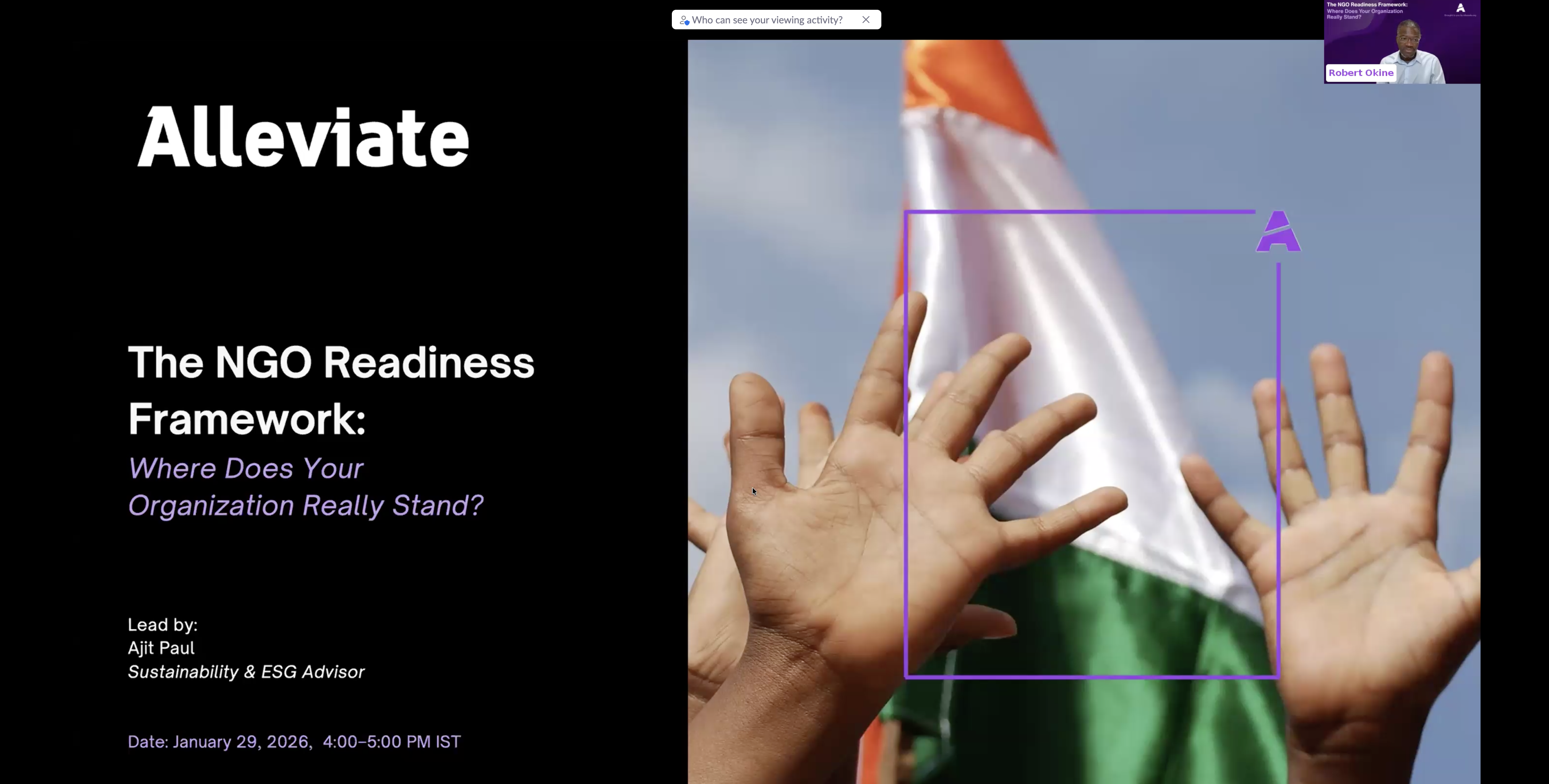

Last week, Alleviate hosted an energizing and deeply insightful webinar titled “The NGO Readiness Framework: Where Does Your Organization Really Stand?” for social impact leaders across India. The session brought together practitioners, thinkers, and nonprofit executives for a candid conversation about what it truly takes for NGOs to deliver sustainable, measurable impact in an increasingly complex environment.
Led by Company Founder and CEO, Robert Okine, and guided by expert facilitator and board member at Bewsys, Ajit Paul, the discussion unpacked the realities many NGOs face but rarely have the space to explore. Joined by Dr. Bharat Bhushan of the Muskan Foundation, the session blended lived experience, strategic frameworks, and practical tools that left participants with a clearer understanding of their organizational strengths and gaps.
What emerged was a powerful reminder: readiness is not a checkbox. It is a continuous journey that determines whether an organization can truly fulfill its mission.
Why NGO Readiness Matters More Than Ever
Robert Okine opened the session by grounding the conversation in a simple truth: passion alone is not enough. Social impact organizations must be equipped with the systems, clarity, and strategic alignment needed to sustain their work. Ajit expanded on this by sharing examples from Bewsys’ collaborations with UNICEF and the Pacific Community, illustrating how even well-resourced organizations struggle when internal systems don’t match ground-level realities.
For NGOs in India, these challenges are amplified by regulatory requirements, data protection mandates, and the growing expectation to demonstrate measurable outcomes. As Ajit noted, “Mission-driven work must be paired with strategic positioning if we want to maximize social return on investment.”
This balance between heart and structure is where many organizations stumble.
The CSR Landscape: Opportunity Meets Complexity
One of the most eye-opening segments of the webinar focused on India’s CSR ecosystem. With 28,000 companies now required to contribute to social causes and 35,000 crores allocated for CSR activities, the potential for impact is enormous. Yet, as Ajit explained, the reality is far more nuanced. Many companies struggle with multi-year commitments, and NGOs often face uncertainty in securing sustained funding.
Dr. Bharat Bhushan brought this to life through his experience at the Muskan Foundation, which supports individuals navigating substance abuse challenges. He spoke candidly about the difficulty of retaining staff, addressing community stigma, and meeting funders’ expectations, especially when those expectations don’t align with on-the-ground realities.
His reflections underscored a critical point: funding is not just about money. It is about readiness, credibility, and the ability to demonstrate impact.
Introducing the Five Pillars of NGO Readiness
A central highlight of the session was Ajit’s breakdown of the five pillars that determine an organization’s readiness:
- Mission & Strategy Clarity
- Stakeholder Positioning
- Program Design
- Evidence & Storytelling
- Systems Governance
These pillars form the backbone of the NGO Readiness Framework, a practical, reflective tool designed to help organizations assess where they stand today and where they need to grow.
To support this process, Robert and Lisa introduced a guided Google Form assessment that allows NGOs to rate themselves across each pillar on a scale of 1 to 5. The goal is not to judge or rank organizations, but to spark honest reflection and identify actionable next steps.
A Pathway Toward Transformation
The session concluded with an invitation for organizations to go deeper. Alleviate’s team shared details about a structured 4–6 week readiness program designed to help NGOs strengthen their foundations, improve impact measurement, and build the systems needed for long-term sustainability.
Participants were encouraged to stay connected through LinkedIn and upcoming events—because this conversation is only the beginning.
Join Us for Future Webinars
If this session is any indication, the NGO sector is hungry for spaces where leaders can learn, reflect, and grow together. Alleviate is committed to creating those spaces. Whether you’re an emerging nonprofit or an established organization seeking to evolve, our upcoming webinars will offer practical insights, expert guidance, and a community of peers navigating similar challenges.
Stay tuned for our next session and take the first step toward strengthening your organization’s readiness for impact.